Showing posts with label photography. Show all posts

Sunday, May 2, 2010

Muskrat Behaviour

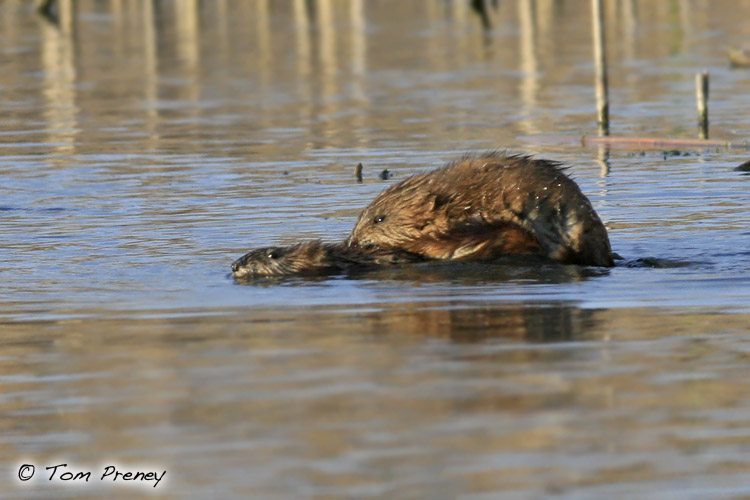
I’ve wanted to photograph muskrats for some time now.  After observing their behaviour from land I decided that a kayak would be the best way to photograph them. I went back the following day launched my kayak and positioned myself outside a large lodge and in a matter of minutes I was photographing some interesting muskrat behaviour.   

The muskrat is the largest member of the vole family. In appearance, muskrats closely resemble beavers; however, muskrats have a long slender tail, unlike the flat tail of the beaver.


Their diet consists of aquatic vegetation, fresh water mussels, fish, and sometimes carrion.


The muskrat's teeth are in front of its mouth allowing it to feed on underwater plants without drowning.


 Muskrats inhabit marshes, shallow lakes, and slow flowing rivers.


  Muskrats live in lodges constructed from aquatic plants and mud and they will often create burrows above the waters edge.


During the breeding season male muskrats mark their territory using scent glands. These glands secrete a musky smelling liquid; giving the muskrat its name. Males will defend their territory sometimes fighting to the death fortunately this fight only lasted a few seconds.


Male chasing female, she was playing hard to get. 


These animals can be found almost anywhere in Canada except the coast of British Columbia.


Muskrat Tracks

Sunday, April 18, 2010

Nesting time!

Today on a walk through Ojibway Park (www.ojibway.ca) I discovered a female Downy Woodpecker hollowing a hole inside a dead ash tree. I observed the bird for over 30 minutes watching and photographing as she dug deep inside the tree. Here are a few images that go along with the story. I'll be keeping an eye out to see if she decides to nest inside this particular tree. 


Monday, October 26, 2009

Snake Road

Every year during the spring and fall a unique road in the Shawnee National Forest in Southern Illinois is closed off due to "the snake migration." These reptiles spend their summer foraging in the surrounding swampland. In fall these snakes seek hibernation in the crevices of the limestone bluffs, bordering the southern portion of the swamp. Snakes are not the only animals utilizing these bluffs for hibernation; lizards, newts, salamanders, frogs and toads also call this place home.


For the last few years I have been able to experience the fall migration. It was amazing exploring Snake Road and photographing the large diversity of herpetofauna this wetland has to offer. We found over 30 species of herps (reptiles and amphibians) during each visit to the road. If you are into nature and want to see a natural phenomenon I would recommend a trip to the Shawnee National Forest.


Here are a few of the many photographs I've taken on my short but memorable visits to "The Road."


Timber Rattlesnake


Western Cottonmouth


Rough Green Snake


Black Rat Snake


Western Mudsnake

Shawnee Kingsnake


Yellow-bellied Watersnake


Green Tree Frog


Southern Leopard Frog

Northern Cricket Frog


Bird-voiced Tree Frog

While photographing this little frog decided to jump on Steve's tripod
(Look carefully!)

Dwarf American Toad

Fowlers Toad

Central Newt

Mole Salamander

Slimy Salamander

Cave Salamander

Yellow Spotted Salamander

Marbled Salamander

Fence Lizard

Ground Skink

Five-lined Skink


Monday, September 28, 2009

Kayak Photography


Kayak photography allows the photographer to obtain images that were never thought possible. It is an unobtrusive way to observe wildlife and their behaviours. Most important you don't need to spend thousands of dollars on a super telephoto lens to achieve quality images. This Fall I have been visiting Point Pelee National Park and Kayaking in the marsh to photograph shorebirds. I find the best time to go is in the evening because the shorebirds are landing in the marsh to roost for the night and also the lighting is ideal for photography. The mudflats in which the marsh provides is a great place to start looking for these birds. I use a Canon 300mm F/4 IS lens to do most of my kayak photography. The majority of the birds I have encountered are very cooperative and allow for many great photo opportunities. Here are some of my photographs I have taken this year while kayaking.


WILLET


SEMIPALMATED SANDPIPER

Steve Pike

DUNLIN

WHIMBREL

HUDSONIAN GODWIT


Me photographing the Godwit (Photo By: stevepike.com)

SEMIPALMATED PLOVER

GOLDEN PLOVER

SHORT-BILLED DOWITCHER

LOND-BILLED DOWITCHER