Monday, May 24, 2010

Morels

I've been wanting to eat morels for a long time, but usually when I find them, I either find too few or more than I'm prepared to collect. This spring I brought a couple home to try; a lot of people had told me how delicious they are so I wanted to see what I was missing out on.  I found a recipe on the internet and my wife and I cooked them and we were both blown away by the flavour of these mushrooms!  I'll definitely not pass another morel without picking it--they're just too good.  


Morels are easily identified, which make them a choice edible. 


The recipe I used was simple.  First clean the mushrooms, making sure all the sand and bugs are gone. For some reason, wood louse (potato bugs) love to hide inside the hollow stems.  After a good wash,  soak the mushrooms in a bowl of salt water overnight to kill any unwanted visitors that cannot be seen with the naked eye.  The following day, make sure to rinse the mushrooms one last time before you cook them.  Heat a medium frying pan with a half inch of vegetable oil.  Dip the morel into an egg, roll it in bread crumbs (I like using cajun Fish Crisp) and place it into the pan.  Cook until golden brown; this only takes a few minutes.  There are many awesome recipes that I have found online, but now that morel season is done I'll have to wait until next year to try them.


Monday, May 17, 2010

Mute Swans

Mute Swans were introduced to North America from Eurasia in the 1800's as an ornamental bird, but now they can be found here in great numbers.  These elegant birds can be detrimental to other species of waterfowl because of their large numbers and voracious appetite.  The aptly named Mute Swan is less vocal than other swan species; however they will make many different noises such as grunting, whistling and hissing. 


Mute Swans can be easily distinguished from other species of swans from their orange bill and large protruding black knob above the bill. 


Mute Swans construct large nests in shallow water using aquatic vegetation.  The nest in the picture below was constructed from cattails.


Mute Swans usually lay 5-8 eggs per clutch; however as many as 11 eggs have been recorded.


Young swans are called cygnets.  I counted a total of seven in this nest and was lucky enough to watch one hatch from its egg!  Even though the Mute Swan is an invasive species, it's a fascinating and beautiful bird that I enjoyed observing in the wild.

Sunday, May 2, 2010

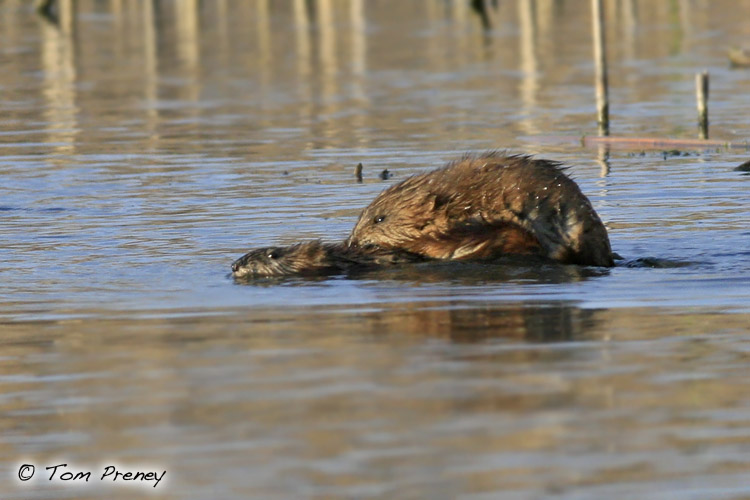
Muskrat Behaviour

I’ve wanted to photograph muskrats for some time now.  After observing their behaviour from land I decided that a kayak would be the best way to photograph them. I went back the following day launched my kayak and positioned myself outside a large lodge and in a matter of minutes I was photographing some interesting muskrat behaviour.   

The muskrat is the largest member of the vole family. In appearance, muskrats closely resemble beavers; however, muskrats have a long slender tail, unlike the flat tail of the beaver.


Their diet consists of aquatic vegetation, fresh water mussels, fish, and sometimes carrion.


The muskrat's teeth are in front of its mouth allowing it to feed on underwater plants without drowning.


 Muskrats inhabit marshes, shallow lakes, and slow flowing rivers.


  Muskrats live in lodges constructed from aquatic plants and mud and they will often create burrows above the waters edge.


During the breeding season male muskrats mark their territory using scent glands. These glands secrete a musky smelling liquid; giving the muskrat its name. Males will defend their territory sometimes fighting to the death fortunately this fight only lasted a few seconds.


Male chasing female, she was playing hard to get. 


These animals can be found almost anywhere in Canada except the coast of British Columbia.


Muskrat Tracks

Wednesday, April 28, 2010

Spring Wildflowers

Today I went for a walk at Brunet Park in LaSalle, Ontario. This park has a spectacular display of spring wildflowers.  Here are a few photographs of the species I discovered flowering. All the photos were taken with my Sigma 105mm macro lens attached to my Canon 30D.


White Trillium 


Jack-in-the-Pulpit 


Trout Lily 


Wild Geranium 


Early Meadow Rue


Wild Oats 


Blue Violet 

Purple Cress 

Monday, April 19, 2010

Prescribed Burns

Fire is essential to the survival of the oak savanna and tallgrass prairie. Without it these diverse ecosystems would disappear along with their unique flora and fauna. Prescribed burns are conducted safely by professionals and mimic naturally occurring fires such as lightning strikes. The same people who fight forest fires are the ones performing these controlled burns. Fire will help accelerate growth of the prairie species, eliminate shrubby vegetation and provide the soil with extra nutrients. In addition it will also help deal with invasive species ie. Black Locust, Japanese Honeysuckle, and Common Buckthorn.

This spring two prescribed burns were undertaken in the Ojibway Prairie Complex. Here are some photo/videos.


Ojibway Prairie Provincial Nature Reserve


Black Oak Heritage Park


Sunday, April 18, 2010

Nesting time!

Today on a walk through Ojibway Park (www.ojibway.ca) I discovered a female Downy Woodpecker hollowing a hole inside a dead ash tree. I observed the bird for over 30 minutes watching and photographing as she dug deep inside the tree. Here are a few images that go along with the story. I'll be keeping an eye out to see if she decides to nest inside this particular tree. 


Sunday, April 11, 2010

Great Horned Owl Nest

This evening my friend and I went to photograph a pair of nesting Great Horned Owls. When we approached the nest the adult flew from its nearby perch but landed a couple hundred yards away. It was difficult to find the owl after it flew but after a thorough search the bird was relocated. It was almost impossible to get a photo of the adult; however, I was able to get some photos of the young owls. The nest was approx 8o' high so this was the best I could achieve with my set up (Canon 30D 300mm+ 1.4X teleconverter). The owlets would pop their heads up every now and again which allowed me to get this shot. As we were leaving the adult owl was mobbed by crows, but the bird stayed perched and didn't seem too bothered. I hope to photograph the owls a few more times before they leave the nest.

Great horned Owls (Original)

Great Horned Owls (cropped from original)